Schumann Resonance Today
Right now the Schumann resonance reads Elevated, score 45 of 100. Fundamental mode near 7.83 Hz, within its usual range. Geomagnetic field Kp 1.7 (No storm).
Right now
- Status
- Elevated 45/100
- Frequency
- 7.83 Hz
- Kp Index
- 1.7
- Observatories
- 5 / 6
5 of 6 observatories reporting · Updated 11 min ago Which stations are live — map Yesterday and the last 30 days

Last updated:

Last updated:

Last updated:

Last updated:

Last updated:
Last updated:
Explore
Pressure-Drop Headache Score
Barometric pressure + solar activity rolled into a daily risk index for 8 cities.
Check todayWhat Am I Looking At?
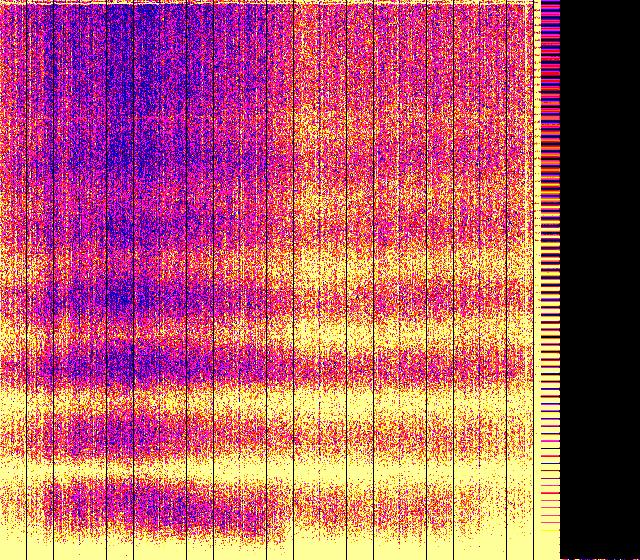
Each spectrogram shows electromagnetic energy between 0 and 50 Hz captured by a ground-based VLF receiver. The bright horizontal bands near 7.83, 14.3, 20.8, 27.3 and 33.8 Hz are the Schumann resonances — standing waves that form between the Earth's surface and the ionosphere.
Brighter colors mean stronger signal. When a geomagnetic storm hits, the whole spectrogram lights up — multiple bands brighten simultaneously, scores rise, and you may notice effects on sleep, mood, or focus.
We combine pixel-level analysis of these spectrograms with AI vision models to derive the activity score and status you see on the homepage. Six independent stations across three continents reduce single-source bias.
How We Score It
Our pipeline analyzes each spectrogram in two passes. First, a pixel analyzer measures the brightness of each Schumann band relative to a dynamic baseline. Then an AI vision model (Gemini Flash) examines the full image for patterns humans might miss — broadband excitation, harmonic splitting, data gaps.
The final score (0–100) is the higher of the two: pixel floor guarantees the score reflects objective signal strength, while the AI can flag subtle anomalies. Six stations are averaged with equal weight — so a storm that only appears on one station won't dominate the score.
Questions people ask today
Is the Schumann resonance high today?
Slightly. The network is at Elevated (45/100): amplitude is above the daily norm at one or more stations, usually because thunderstorm activity is strong or the geomagnetic field is mildly disturbed. Somewhere in the tropics this happens most days; it is not a warning.
What is the Schumann frequency today?
The fundamental mode is near 7.83 Hz. It drifts with the height of the ionosphere and the position of thunderstorm activity; a swing of a few tenths of a hertz over a day is textbook behavior.
What makes the Schumann resonance spike?
Lightning. The resonance is powered by roughly fifty lightning flashes a second worldwide, so amplitude climbs when the thunderstorm centers over Africa, the Amazon and Southeast Asia are busiest. That is the daily and seasonal rhythm you see in the spectrograms. Geomagnetic storms reshape the ionosphere, the upper wall of the cavity, and can sharpen or smear the peaks. A spike that shows on one station and nowhere else is almost always local interference or a stuck sensor, which is why we compare stations before calling anything a spike.
Why do other sites show a different picture?
Most of them republish a single spectrogram from Tomsk, sometimes one that stopped updating months ago. We read up to six observatories on three continents, drop any that have gone stale, and tell you how many are actually reporting, because a "live" reading you cannot verify is just a picture.
Explore
See Tonight's Aurora Odds
Live Kp forecast + visibility map — find out if the lights reach your latitude tonight.
Open forecast