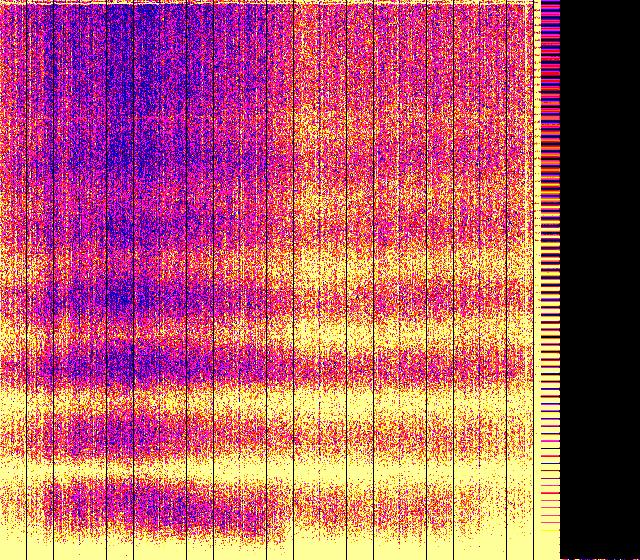
Earth's electromagnetic pulse is currently calm, with a global activity score of 37/100. While most monitoring stations show stable, quiet resonance patterns, there are some gentle increases in activity observed around the 14 Hz frequency band, indicating a subtle energetic shift.
Updated 24 min ago
Solar Activity
324
Solar Wind
km/s
-1.0
IMF Bz
southward nT
10%
Solar Flares
M-class · X: 1%
Live solar wind, magnetic field and flare data from NOAA Space Weather.
Earth's electromagnetic pulse is showing a gentle increase in activity, particularly around the 14 Hz frequency band. The fundamental 7.83 Hz resonance remains stable, but you might notice some int...
The rightmost portion of the spectrogram shows stable, thin horizontal lines at the expected Schumann resonance frequencies. The PSD panel confirms moderate, well-defined peaks at the fundamental a...
At the rightmost edge, the ULF (purple) and ELF (pink) noise levels are settled near -70 dB and -75 dB respectively. The geophone (green) signal has returned to its baseline level near -80 dB after...
The rightmost portion of the spectrogram shows sustained, elevated power levels across the lower frequency bands. The PSD panel confirms significant spectral density peaks corresponding to the fund...
The rightmost portion of the chart shows sustained high-intensity activity with bright yellow and pink horizontal bands across the primary Schumann resonance frequencies. The PSD panel confirms ele...
The rightmost portion of the spectrogram displays intense yellow and white coloration, indicating high signal amplitude across all Schumann harmonic bands. The PSD panel on the far right confirms t...
Station Health
Tomsk, Russia
100%
ETNA, Sicily
100%
Cumiana, Piedmont
100%
Eskdalemuir, UK
100%
California, USA
100%
Alberta, Canada
0%
--
Meet the Stations
Tomsk
RU
Siberian Physical-Technical Institute, Tomsk State University
Tomsk, Russia (55.1°N, 82.9°E)
Continuously monitoring Schumann Resonance since 2005 with a custom receiver covering all five fundamental modes (7.83 to 33 Hz). The public spectrogram feed is one of the most widely referenced Schumann data sources worldwide.
Magnetic coil sensor positioned on the slopes of Mount Etna in Sicily. Exceptionally low anthropogenic noise combined with active volcanic geology makes this one of Europe's most distinctive Schumann observation sites.
Citizen-science VLF/ELF station in Piedmont, northern Italy, operated by Renato Romero (IK1QFK). Over two decades of continuous monitoring. The vlf.it data stream adds mid-latitude European coverage between ETNA and BGS Eskdalemuir.
Part of the British Geological Survey, Eskdalemuir has monitored Earth's geomagnetic field since 1908. One of the world's premier observatories, its ELF spectrogram data offers scientific-grade Schumann Resonance measurements with calibrated frequency and power axes.
HeartMath Institute's Global Coherence Initiative station in Boulder Creek, California. Part of a worldwide network studying the relationship between human health and Earth's magnetic fields. Provides daily 24-hour spectrograms of Schumann Resonance activity.
HeartMath Institute's Canadian monitoring station in Alberta. Together with the California site, it provides North American coverage for Schumann Resonance monitoring, enabling cross-validation between continents.
Conditions are expected to remain calm over the next 24-72 hours, with the Kp forecast indicating a maximum of 2.0. The slow solar wind and near-neutral IMF Bz suggest a low probability of significant geomagnetic disturbances that would typically intensify Schumann resonance.
Wellness Tip
This is a favorable time for grounding practices and mindful relaxation to harmonize with the Earth's stable pulse.